Xing or LinkedIn — which is worth more in Switzerland?
Updated:
In short
In Switzerland LinkedIn is worth more, and the gap is wider than most people expect. On 25 August 2026 Xing returned just over five thousand jobs for Zurich, 42 for Lausanne and 11 for Lugano; LinkedIn returned over twenty-nine thousand, over eleven thousand and 963 for the same three cities. Xing is a German-language product for the German-speaking market and describes itself that way — «21 Mio. XING Mitglieder in D-A-CH». In German-speaking Switzerland it is a reasonable second profile; in the French- and Italian-speaking regions it is close to empty. Checked 25 August 2026.
Who to choose
With Xing it ends at the advert. With us it starts there: the same posting produces the CV, the motivation letter, the check against it, and the entry in your RAV record.
Choose Xing if
Xing — rooted in the German-speaking market, for DACH contacts and companies that maintain a profile there.
German-language network — for Germany, Austria and Switzerland; much thinner here than LinkedIn, but present at German employers.
For applications into Germany — looking from Switzerland towards DE or AT, it carries employers who are thinner on LinkedIn.
Choose LinkedIn Jobs if
Network instead of a form — the profile is the application, "Open to work" signals availability to recruiters, and some roles appear nowhere else.
Management and international — strongest at international employers and senior roles, thin in trades, care and retail.
Choose SwissJobs.app if
Pick the job directly — We run the job index ourselves. The advert text is already loaded, and everything else is written against exactly that text — no searching, no copying, no pasting.
Four tools, not one — CV, motivation letter for the same advert, a CV check against that advert, and interview preparation — one account, the same data.
The RAV sheet — Your job-search efforts are filled from your application tracker and printed as the official SECO form. No other tool in this comparison has it.
Word export, no watermark — PDF and DOCX, both clean. Many tools hand you a text file on the free plan, or stamp a watermark on the document.
Start without an account — The tools open without signing up. The account is asked for to save and from the second document — the first download needs none.
The Swiss job portals at a glance
Click an image for the full-size view. What each portal actually is stands beside it.
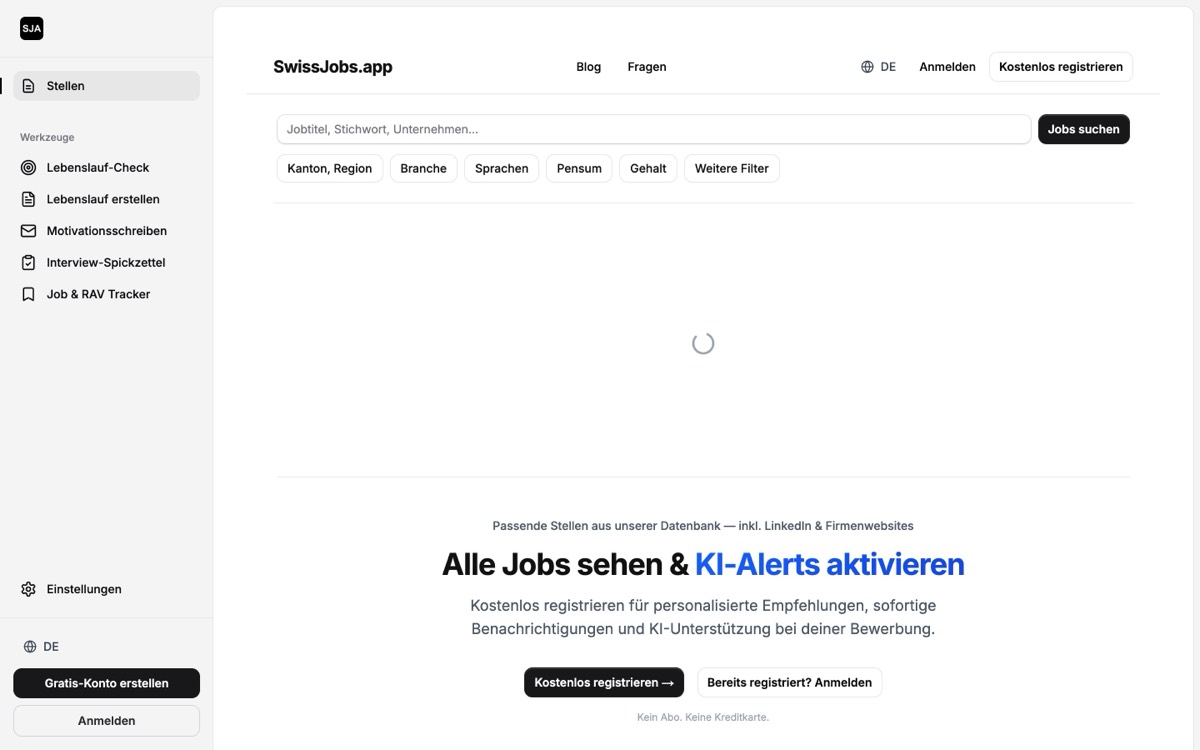
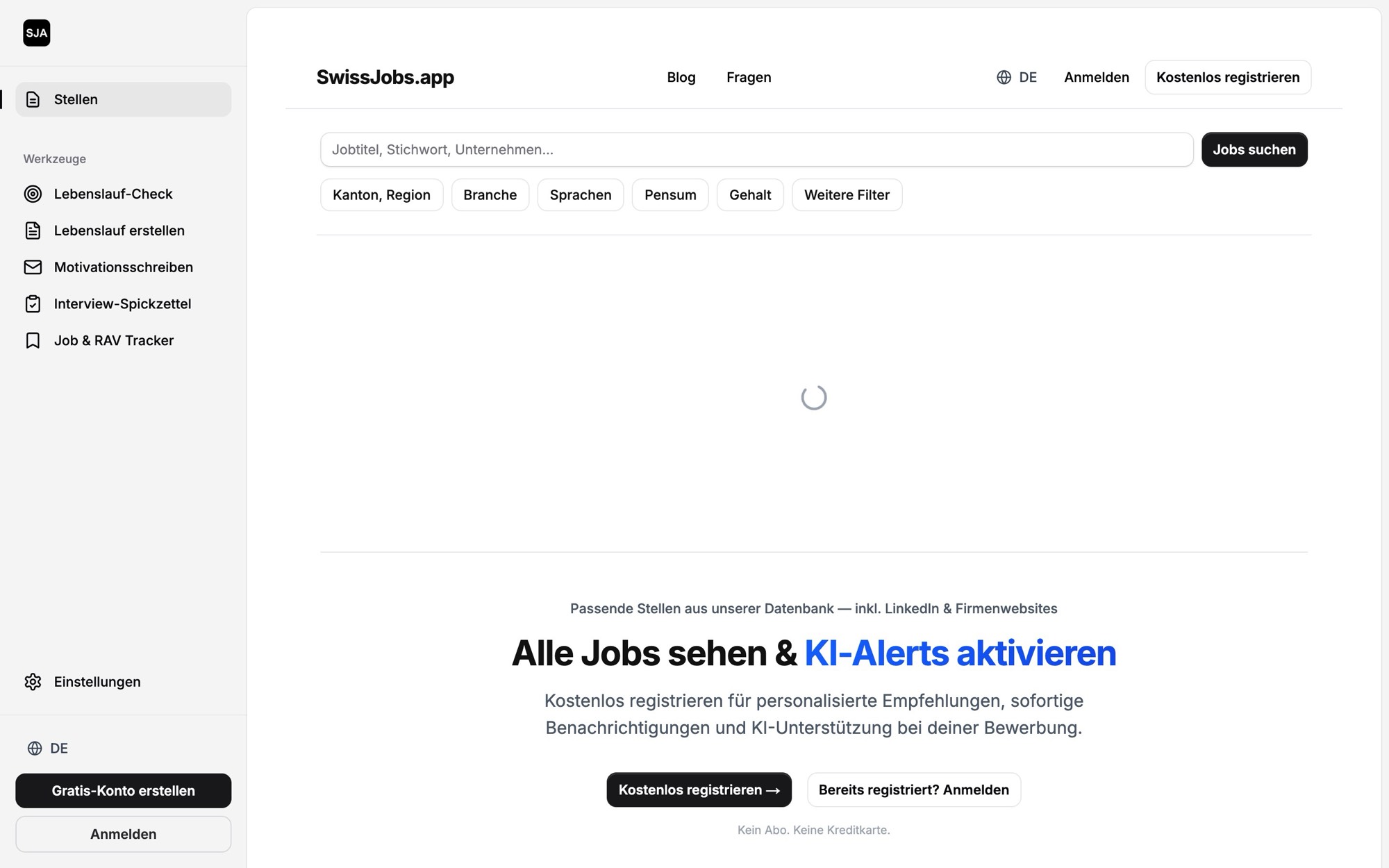
1. SwissJobs.appOur app
Over 21,000 open Swiss roles from ATS systems, company sites and LinkedIn in one place — and from any advert, straight into a CV, a motivation letter, a CV check and interview prep. The RAV job-search-efforts form fills itself from your application tracker. Free to use; the account is asked for at save.
The best reputation for English-speaking and international roles in Switzerland. Considerably thinner for trades, care and commercial roles.
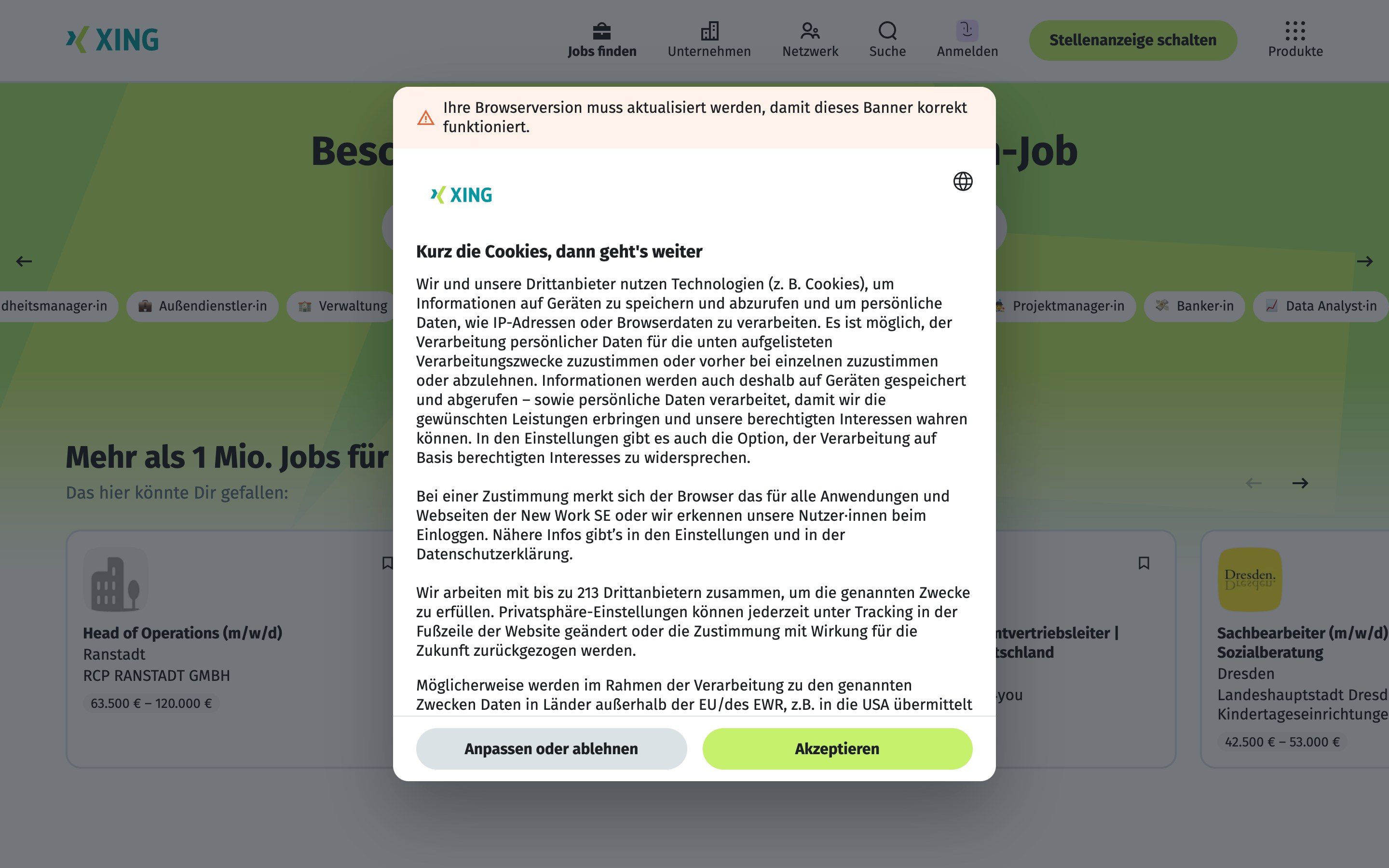
If you have never used it: Xing is the professional network that dominated Germany, Austria and German-speaking Switzerland before LinkedIn arrived. Plenty of people who moved here from Germany still have a profile, and the question is whether it is worth maintaining alongside a LinkedIn one. That is not a feature question. It is a question about where in Switzerland you are looking and in which language your occupation is advertised.
So what follows is a query rather than an opinion. On 25 August 2026 we entered the same Swiss cities on both platforms without logging in, recorded what each returned, opened individual adverts and checked where the listings actually come from. Everything below is visible without an account and can be re-checked in a browser.
Public Xing job search, queried without an account, one location at a time, figure taken from the «Jobs gefunden» line. The ranking falls off precisely at the language border.
- Queried on 25 August 2026, both platforms without an account, the same cities on the same day.
- Xing results: Zurich just over five thousand, Basel close to two thousand seven hundred, Bern a little over nineteen hundred, Lucerne close to fourteen hundred, Winterthur and St. Gallen a little over a thousand each — then Geneva 125, Neuchâtel 53, Lausanne 42, Sion 15, Lugano 11. Exact values are in the chart.
- LinkedIn the same day: Zurich over twenty-nine thousand, Basel over twenty-five thousand, Bern over twenty-two thousand, Lausanne over eleven thousand, Geneva over five thousand, Lugano 963.
- Searching Xing with the location «Schweiz» returns jobs in Hamburg, Berlin, Vienna and Villach priced in euros; the city-level search works, the country-level one does not.
- xing.com/fr and xing.com/it both redirect to the English home page. Xing runs in German and English; LinkedIn also runs French and Italian editions of its Swiss city pages.
- Xing on itself: «21 Mio. XING Mitglieder in D-A-CH». LinkedIn on itself: «more than 1 billion members in more than 200 countries and territories worldwide».
- Application links on the Xing result lists led away to third-party sites in 13 of 15 cases for Zurich, 14 of 15 for Zurich nursing roles and 19 of 19 for Geneva; several are labelled «Externes Job-Angebot. Von einem Partner.»
- The franc figures on Xing are a «Gehalts-Prognose» — an estimated average for comparable positions, not the employer's number.
- In our own index no application link goes to Xing and the LinkedIn share rounds to zero; just over 38 per cent point at a .ch address.
- 18.9 per cent of the adverts we can place in a canton are in GE, VD, TI, NE or JU — 24.7 per cent counting Valais and Fribourg.
Feature comparison
| Feature | SwissJobs.app | ||
|---|---|---|---|
| Swiss job listings | Yes | not stated | Yes |
| All 26 cantons | not stated | not stated | Yes |
| Search without an account | not stated | not stated | Yes |
| Job alerts by email | not stated | not stated | Yes |
| AI match against your profile | No | Yes | Yes |
| Build a CV straight from the advert | No | not stated | Yes |
| Motivation letter for the advert | No | not stated | Yes |
| CV check against that advert | No | not stated | Yes |
| Application tracker | No | not stated | Yes |
| RAV job-search-efforts form (SECO) | No | not stated | Yes |
| Low-competition listings surfaced | not stated | not stated | Yes |
| Free to use | not stated | not stated | Yes |
| Interface languages | not stated | not stated | DE / EN / FR / IT |
| Built in Switzerland | not stated | not stated | Yes |
As of 4 September 2026. "not stated" means it could not be read on their own site — not "does not exist". Our rows come from the code (lib/stripe/trialConfig.ts) and from walking the live flow, not from marketing copy.
Pricing side by side
| What you pay | SwissJobs.app | ||
|---|---|---|---|
| Job searchThe search is not part of our subscription. What is paid for is the tools that come after it. | Free for jobseekers | Free for jobseekers | Free — search, filters, job alerts and the application tracker cost nothing |
| Monthly price | not stated | not stated | CHF 15 — all six tools, one subscription |
| Yearly price | not stated | not stated | CHF 95 a year (= CHF 7.92 a month) — the same six tools |
| Free trialOur seven days are the full product, not a limited preview. | not stated | not stated | 7 days, full access, cancel any time |
| What works without payingWe print the limit, because that is the number a comparison usually leaves out. | not stated | not stated | Tools open without an account; free account: 5 documents/day, 10 per rolling week |
| Currency | not stated | not stated | CHF |
| BillingWatch for four-week billing periods anywhere: that is 13 charges a year, not 12. | not stated | not stated | Calendar month, cancel any time |
As of 4 September 2026. "not stated" means it could not be read on their own site — not "does not exist". Our rows come from the code (lib/stripe/trialConfig.ts) and from walking the live flow, not from marketing copy.
Eleven Swiss cities, two platforms, one day
Both platforms print a result count above the list. Xing gives an exact figure («Jobs gefunden»), LinkedIn a rounded one with a plus sign. The two figures are not directly comparable — each counts, rounds and defines a city radius its own way. What is comparable is the ratio inside a single platform: how does Zurich stand to Lausanne, on Xing and on LinkedIn?
On Xing that day: Zurich just over five thousand, Basel close to two thousand seven hundred, Bern a little over nineteen hundred, Lucerne close to fourteen hundred, Winterthur and St. Gallen a little over a thousand each. Then it collapses: Geneva 125, Neuchâtel 53, Lausanne 42, Sion 15, Lugano 11. Zurich to Lausanne is a factor of roughly 127.
On LinkedIn the same day: Zurich over twenty-nine thousand, Basel over twenty-five thousand, Bern over twenty-two thousand, Lausanne over eleven thousand, Geneva over five thousand, Lugano 963. Zurich to Lausanne is a factor of roughly two and a half. That difference is the whole finding. Xing being smaller is unsurprising; Xing all but disappearing west and south of the language border while LinkedIn keeps working there is the part that decides the answer.
Inside German-speaking Switzerland the picture is friendlier to Xing. Winterthur, St. Gallen and Lucerne each returned a little over a thousand results, which is enough for a second search pass, and employers such as Spitex Kanton Zug turned up in the lists. If you are job-hunting in Zurich, Basel, Bern or central Switzerland, a Xing profile you already have is not wasted effort.
Xing does not treat «Switzerland» as a place
The most striking result came from the most obvious thing to try. Enter «Schweiz» as the location on Xing and you get a list of well over half a million results whose first page holds jobs in Hamburg, Berlin, Magdeburg, Bremen, Braunschweig, Vienna and Villach, with salaries in euros — while the sidebar states «Suchgebiet: Nur in Schweiz» (search area: only in Switzerland). City-level search works properly: «Genève» returns Geneva jobs priced in francs, «Bellinzona» returns a handful. The country-level search does not. Someone opening Xing for the first time to look for Swiss work is therefore likely to start with the one query that fails.
The second constraint is language. Xing exists in German and English and nothing else. Both xing.com/fr and xing.com/it redirect to the English home page, and requesting the Lausanne result list with a French language preference still returns a German interface, with «Vollzeit», «Karriere-Stufe» and «Gehalt» as the filter labels. LinkedIn runs separate language editions of the same city pages: the French one heads the Lausanne list with «offres d'emploi» and a count above eleven thousand, the Italian one with «930 offerte di lavoro» for Lugano.
This is the business model rather than an oversight. On its own recruiting site Xing describes its talent pool as «21 Millionen Talente im deutschsprachigen Raum» — 21 million people in the German-speaking area — and prints «21 Mio. XING Mitglieder in D-A-CH» as a headline figure. The CH in D-A-CH means German-speaking Switzerland; Romandie and Ticino are not part of the promise. LinkedIn, for its part, calls itself «the world's largest professional network with more than 1 billion members in more than 200 countries and territories worldwide» and has been owned by Microsoft since December 2016.
For a country with four national languages that distinction matters more than any feature list. The Federal Statistical Office reports that 41% of the employed population in Switzerland use more than one language at work at least once a week. A platform available in one national language is not a platform for this labour market; it is a platform for one part of it.
Where the Swiss listings on Xing come from
We read the application links embedded in three Xing result lists. In the Zurich list, 13 of 15 of those links carried a marker showing the click had come from xing.com and led away to another site. In a nursing search for Zurich it was 14 of 15; in the Geneva list, 19 of 19.
The destinations tell the story. Zurich links went to jobimpuls.ch, rocken.jobs, stbpersonal.ch, workmanagement.ch and zentraljob.ch; the nursing ones to stadt-zuerich.ch, zentraljob.ch, clickjob.ch and sozjobs.ch; in Geneva, eight of nineteen went to ch.talent.com, an aggregator, alongside Coop, Globus, Richemont and Vontobel. Several results are openly labelled «Externes Job-Angebot. Von einem Partner.» — an external offer from a partner. Much of the Swiss inventory on Xing was not posted there; it was collected. That is why Geneva has 125 results at all, and why they look so different from the Zurich ones.
One detail is worth knowing before you read a Xing salary. The franc figures shown on Swiss listings do not come from the employer. Xing labels them «Gehalts-Prognose» and the legend reads «Geschätztes Durchschnitts-Gehalt für vergleichbare Positionen» — an estimated average for comparable positions. A Zurich nursing advert showed «95.000 CHF – 108.000 CHF» although the advert itself names no salary. Useful as orientation, not as a negotiating base.
And like LinkedIn, Xing has no field for the Swiss Pensum, the workload stated in per cent. A City of Zurich advert titled «80–100 %» was listed under «Art der Beschäftigung» as «Vollzeit», full time. The percentage survives only in the title the employer wrote.
What Xing is still good for
Three things, and they are real. First, Germany and Austria. If you might move back, if you want to be visible inside a German parent company, or if you are weighing employers on both sides of the border, Xing still reaches parts of the German Mittelstand that LinkedIn does not. The country-level search that fails for Switzerland works perfectly for Germany.
Second, language. Xing is a German product built for German speakers rather than an American one translated into German. If you are more comfortable writing about your career in German than in English, that is a genuine advantage — LinkedIn's German help pages lag behind the English ones and the vocabulary is often translated rather than native.
Third, what is visible without logging in. The posting date, the full advert text and the salary estimate are readable on Xing without an account. The platform also publishes its own reach figures: «30 % Antwortrate auf Recruiter·innen-Anfragen» (a 30% reply rate to recruiter approaches) and «20 Mio. Stellenmarkt-Besuche pro Monat» (20 million job-market visits a month). Those are Xing's own numbers and they cover D-A-CH as a whole, so they say nothing specific about Switzerland.
What Xing should no longer be credited with is the networking part. Its own home page now reads «XING - Finde den Job, der zu Dir passt. Oder lass Dich finden!» — find the job that suits you, or get found — and what it promotes is job search, job preferences and a CV as a PDF. Xing today is a job platform first and a network second.
What actually decides a Swiss application
For this labour market both networks are a route rather than a destination. In our own index of Swiss vacancies, not a single advert sends its application to Xing, and the share sending it to LinkedIn rounds to zero per cent. Just over 38 per cent of application links point at a .ch address and the rest at employer career pages and applicant systems. In Switzerland the application almost always ends up on a company's own site — the platform is how you got there.
Geography is the second factor. Of the adverts in our index that can be placed in a canton, 18.9 per cent sit in Geneva, Vaud, Ticino, Neuchâtel or Jura; add the bilingual cantons of Valais and Fribourg and it is 24.7 per cent. 15.5 per cent of all adverts with a detectable language are written in French or Italian. That is the size of the market a German-only network leaves out, and the reason this question has a different answer in Lausanne than in Winterthur.
The third factor is the dossier. Neither a Xing nor a LinkedIn profile represents what a Swiss employer actually receives: Arbeitszeugnisse (the written employer references, one per job), a Zwischenzeugnis if you are still employed, the workload as a Pensum in per cent, your permit — B, C or G — if you are not Swiss, and language levels stated as B2 or C1 rather than «fluent». It is a CV and a dossier, not a resume. A profile is a business card; the dossier is what gets read.
Short version, by reader
Living in German-speaking Switzerland, professional or management role: LinkedIn first, Xing as a maintained second profile if you already have one. Creating one from scratch pays off only if German or Austrian employers are on your list.
Living in the Romandie or Ticino: LinkedIn, plus Swiss job portals in your working language. On the evidence of this query a Xing profile adds nothing there — 42 results for Lausanne and 11 for Lugano is not a job search.
Moving to Switzerland from Germany, or commuting across the border: keep both and swap their roles. Xing for the German side, LinkedIn for the Swiss side. And expect your Swiss profile to need things a German one never asked for — the Pensum in per cent instead of full-time or part-time, Ferien rather than Urlaub, and a Lohn usually counted in thirteen monthly payments.
Nursing, trades, retail, hospitality: both networks are second choice here. On Xing the Zurich nursing results were dominated by staffing agencies and the application links led onward to Swiss portals and hospital sites anyway. Go there directly.
For the search itself you eventually want one place where Swiss adverts from all four language regions can be filtered by canton and Pensum — ours works without an account.
All platform figures were read on 25 August 2026 from public pages without an account: on Xing from the «Jobs gefunden» line of the location search, on LinkedIn from the header of its public city pages, where the number appears rounded with a plus sign. The two series are therefore not comparable against each other; what is compared is the ratio between cities within one platform. Result lists change through the day, so this is a snapshot. The origin of the application links comes from one result list each for Zurich, for nursing roles in Zurich and for Geneva. Our own figures are shares of the adverts open on SwissJobs.app on 25 August 2026; cantons were assigned from the stated location, and only shares are published.
Search Swiss vacancies across all four language regions
Jobs by profession, city or language
Type a profession, a city or a language, the page shows the adverts currently open for it.
By profession
- Consultant
- Project Manager
- Retail Sales
- Nurse
- Nursing & Care
- Administrative Assistant
- Account Manager
- Software Engineer
- Public Administration
- Architect
- Insurance
- Chef
71 more — narrow the search
By work type
Sources
- XING — public job search, location Zurich
- XING — public job search, location Lausanne
- XING Recruiting «Über uns» — 21 million members in D-A-CH
- XING — English home page (xing.com/fr and /it redirect here)
- LinkedIn — public job list for Zurich
- LinkedIn — French edition, Lausanne
- LinkedIn — Italian edition, Lugano
- About LinkedIn — self-description and Microsoft acquisition
- Federal Statistical Office — languages in Switzerland
Related questions
What our job index says about the Swiss market
Computed live from our own index, not quoted from a study. Shares only, as of today.
Language the advert is written in
- Deutsch
- 60%
- English
- 23%
- Français
- 13%
- Italiano
- 3%
Of adverts that state a language requirement, the share asking for
- Deutsch
- 70%
- English
- 43%
- Français
- 21%
- Italiano
- 3%
19% posted in the last 7 days · Largest markets: Zürich 18% · Bern 10% · Genève 5% · Basel 5%